ZEuP – Zeitschrift für Europäisches Privatrecht 3/2026
A new issue of ZEuP – Zeitschrift für Europäisches Privatrecht is now available and includes contributions on EU private law, comparative law and legal history, legal unification, private international law, and individual European private law regimes. The full table of content can be accessed here: https://rsw.beck.de/zeitschriften/zeup. 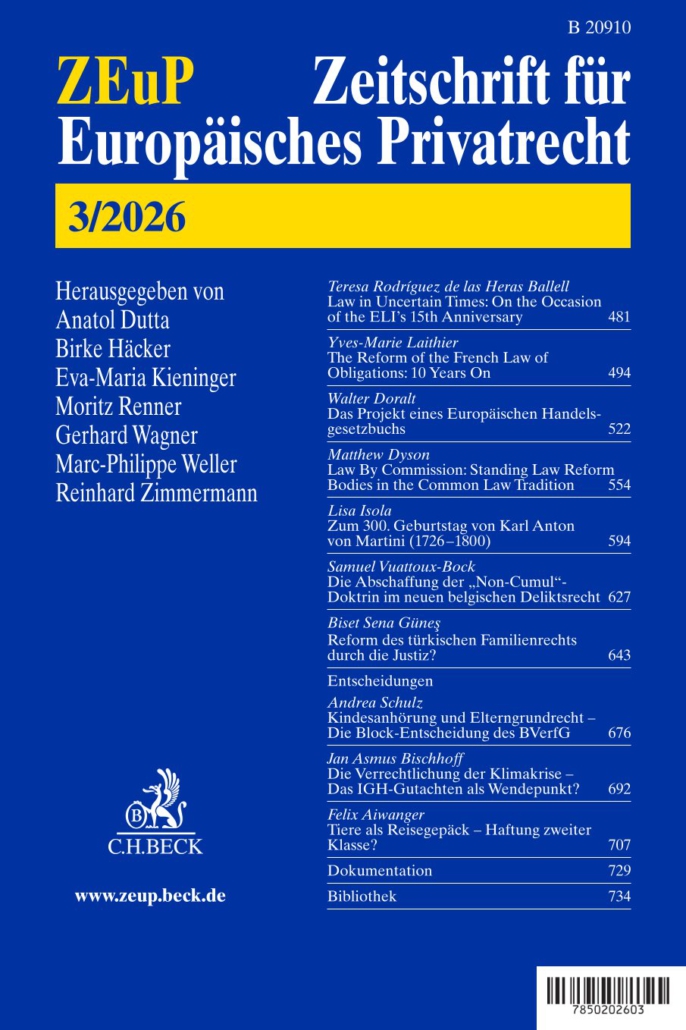
The following contributions might be of particular interest for the readers of this blog with a broader interest in comparative and European private law:
- Teresa Rodríguez de las Heras Ballell: Law in Uncertain Times: Fragilities, Dilemmas and the Role of (Soft) Legal Standards On the occasion of the ELI’s 15th Anniversary
In the editorial, Law in Uncertain Times: Fragilities, Dilemmas and the Role of (Soft) Legal Standards On the occasion of the ELI’s 15th Anniversary, Teresa Rodríguez de las Heras Ballell, reflects on the European Law Institute’s (ELI) contribution to shaping the law in times of global uncertainty on the occasion of its 15thanniversary and envisages the role the ELI is called upon to play in the future. After examining the three challenges and the corresponding fragilities facing the law, the editorial turns to two central dilemmas of contemporary law-making and discusses the harmonisation potential of soft law.
- Yves-Marie Laithier: The Reform of the French Law of Obligations: 10 Years On
In his article, The Reform of the French Law of Obligations: 10 Years On, Yves-Marie Laithier takes a look back and ahead on the tenth anniversary of the French reform of the law of contract, the general regime of obligations, and the proof of obligations. He points out the surprising fact that, as a result of the 2016 reform, the law applicable prior to it (the “old” law) has also been subject to a series of interpretative changes inspired by the perceived need to reduce the gap between it and the provisions newly inserted into the Civil Code (the “new” law). Thus, the reform, designed for the present, has led to a partial rewriting of the law of the past. The article concludes by assessing the future prospects of the reform.
- Walter Doralt: Das Projekt eines Europäischen Handelsgesetzbuchs – Vom Beruf unserer Zeit zur Reform und (Re-)Kodifikation im Handelsrecht
Walter Doralt on Das Projekt eines Europäischen Handelsgesetzbuchs – Vom Beruf unserer Zeit zur Reform und (Re-)Kodifikation im Handelsrecht provides (in German) a brief overview and assessment of the project for a European Commercial Code, which stems from an academic Franco-German initiative. In doing so, he highlights that major law reform initiatives on a European level have often originated in legal scholarship. The article addresses the challenges of translating academic proposals into legislation, as well as the potential benefits and lasting influence of such initiatives on the development of the law.
- Matthew Dyson: Law By Commission: Standing Law Reform Bodies in the Com-mon Law Tradition
In, Law By Commission: Standing Law Reform Bodies in the Common Law Tradition, Matthew Dyson examines the role of law commissions, ie, bodies officially charged with the task of reviewing the law and preparing reform proposals for the legislator to consider. The article explores when and how law commissions are typically created, how they work, what they do, and how successful they have been in the past. The article further considers the spread of law commissions as institutions widely used in common law (and mixed) legal systems. The article also compares law commissions to other bodies engaged in law reform.