Revue critique de droit international privé – Issue 2025/4
Written by Hadrien Pauchard (assistant researcher and doctoral student at Sciences Po Law School)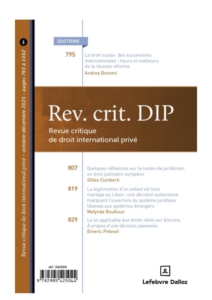
The fourth and last issue of the Revue Critique de droit international privé of 2025 has just been released. It contains four articles, eight case notes, and six book reviews. In line with the Revue Critique’s policy, the doctrinal part will soon be made available in English on the editor’s website (for registered users and institutions).
In the first article, Prof. Andrea Bonomi (Université de Lausanne) conducts an in-depth analysis of “Le droit suisse des successions internationales : heurs et malheurs de la récente réforme” (The Swiss law of international successions: the good and bad fortunes of the recent reform). Described by the author as a true “compromise” à la Suisse, the reform introduces original solutions, which are discussed as follows:
By a statute adopted on 23 December 2023 and entered into force on 1 January 2025, Switzerland has recently reformed its private international law rules in matters of international succession. Inspired by a highly commendable objective of harmonisation, this legislative revision will undoubtedly improve coordination between Swiss law and the European Succession Regulation. This objective is achieved both through a unilateral alignment of certain Swiss rules with those of the European Regulation and through a strengthening of the autonomy of the de cujus. Certain solutions are original and would deserve to be considered by the European legislator in the context of a future revision of the Regulation. However, during its legislative process, the initial draft encountered unforeseen resistance, which led, with regard to forced heirship, to a distinctly Swiss compromise that deprives the reform of part of its effectiveness and coherence.
In the second article, Prof. Gilles Cuniberti (University of Luxembourg) shares “Quelques réflexions sur la notion de juridiction en droit judiciaire européen” (Some thoughts on the concept of jurisdiction in European judicial rules). Surveying both European regulations and case law, the contribution provides a comprehensive overview of this important issue and suggests avenues for reflection to arrive at a consistent and effective approach. Its abstract reads as follows:
The dejudicialization of private law has led the European lawmaker to extend the benefits of European regulations on private international law to non-judicial authorities by broadly defining the concept of ‘court’ within the meaning of these texts. At the same time, the European Court of Justice has embarked on a process of restricting the same concept by excluding decisions rendered by judicial authorities not exercising judicial functions. This contribution examines the varied definitions adopted by the different regulations and questions the appropriateness of the direction taken by case law within the framework of the Succession Regulation. It concludes by proposing a return to a purely organic criterion for decisions rendered by judicial authorities.
In the third article, Dr. Melynda BouAoun (Université Saint-Joseph de Beyrouth & Université La Sagesse) reports on “La légitimation d’un enfant né hors mariage au Liban : une décision audacieuse marquant l’ouverture du système juridique libanais aux systèmes étrangers” (The legitimization of a child born out of wedlock in Lebanon: a bold decision marking the opening of the Lebanese legal system to foreign systems). The groundbreaking ruling gives the author an opportunity to share though-provoking observations on Lebanese family law regarding both jurisdiction and conflict of laws in a pluralist system. They are introduced as follows:
On March 13, 2025, the First Instance Court of Mount Lebanon, competent in matters of personal status and family law, delivered a remarkable decision by recognizing as legitimate a child born out of wedlock to a Lebanese couple belonging to two different religious communities, Shiite and Druze. This article aims to comment on this bold decision, which stands out at a time when issues of filiation — and personal status matters more broadly — continue, in principle, to fall within the jurisdiction of religious authorities in the Lebanese legal system.
The last article is authored by Dr. Emeric Prévost (Université de Kyushu, amongst other affiliations in France and Japan), commenting on “La loi applicable aux droits réels sur bitcoins. A propos d’une décision japonaise” (The law applicable to right in rem over bitcoins. About a Japanese decision). It offers a roadmap for navigating the complex issues raised by the private international regulation of blockchain, which could certainly inspire jurisdictions beyond the archipelago’s waters. The article’s abstract reads as follows:
The decision of 25 April 2024 of the Tokyo District Court is particularly significant in that it is the first to address, under Japanese private international law, the issue of the law applicable to proprietary rights over bitcoins. While a general principle of proximity appears to be affirmed, the judges also expressly refer to the lex situs rule in order to resolve the conflit mobile situation arising from the transfer of bitcoins from one legal system to another. In addition to implicitly recognising the movable nature of bitcoins, the judgment further emphasises the effective control that holders of the private key associated with a unique public address on the Bitcoin network can exercise over the corresponding crypto-assets. The Tokyo judges thus treat control of the private key both as a connecting factor for locating the disputed bitcoins and as an essential condition for property rights created under a foreign law to produce any effect within the Japanese legal order. Finally, the decision also highlights the difficulties in establishing a causal link between alleged breaches of an intermediary’s due diligence obligations and the violation of property rights over crypto- assets such as bitcoins. The decision therefore offers both valuable insights into the current state of the law and an outlook on possible future developments for the private international law of digital finance and crypto- assets.
Since 1957, the fourth issue of the Revue critique includes its annual Bibliographical Index that provides readers with the possibly most comprehensive list of publications in the various branches of private international law from the previous year. Thanks to contributions from Prof. Alejandra Blanquet (Université Paris-Est Créteil), Prof. Christine Budzikiewicz (Phillips-Universität Marburg), Prof. Béligh Elbalti (Osaka University), Prof. Pietro Franzina (Università Cattolica del Sacro Cuore), Prof. Louise Merrett (Cambridge), and Prof. Symeon Symeonides (Willamette University), the 2024 Bibliographic Index will soon be available on the publisher’s website. This multilingual Index includes a large general section devoted to private international law, a special section on international arbitration, and a section dedicated to case law panorama. For 2024, it features a particularly rich segment on Devoir de vigilance (Corporate Due Diligence), but also numerous references on the year’s hottest topics such as Election de for (Choice of court) or Filiation (Filiation).
The full table of contents is available here.
Previous issues of the Revue Critique (from 2010 to 2022) are available on Cairn.