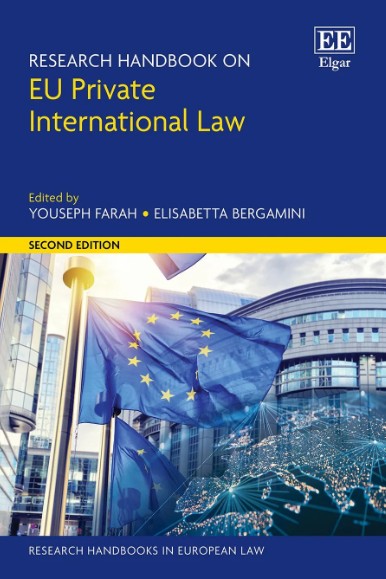
New Publication: Second Edition of the Elgar’s Research Handbook on EU PIL

While much of Europe slows down for August, there is still some fresh academic news to share: the publication of the second edition of the *Research Handbook on EU Private International Law*, edited by Youseph Farah, of the University of East Anglia and Elisabetta Bergamini, of the University of Udine, and published by Edward Elgar Publishing as part of the *Research Handbooks in European Law* series.
Thoroughly revised and updated, the new edition brings together civil-law and common-law perspectives to examine some of the most important questions and continuing challenges in EU private international law. Alongside the traditional fields of jurisdiction, contractual and non-contractual obligations, the Handbook addresses significant developments in family law, parental responsibility and cross-border succession.
Building on the first edition, the volume includes new contributions on class actions and collective redress, party autonomy, behavioural economics, and the harmonisation of private international law in matters of succession and parental responsibility. It also expands the analysis of the Rome I and Rome II Regulations, including the particularly complex questions concerning the law applicable to defamation and privacy.
Further chapters explore parallel proceedings and the EU rules on lis pendens, the relationship between the Brussels I Recast Regulation and arbitration, anti-suit injunctions before and after Brexit, the determination of the lex arbitri in decentralised blockchain-based arbitration, and the application of EU law principles in the fields of civil jurisdiction and arbitration.
The Handbook comprises 16 substantive chapters written by scholars from a range of jurisdictions and legal traditions. By combining analysis of the existing legal framework with critical assessments and proposals for its further development, the volume provides a valuable resource for researchers, teachers, postgraduate students and practitioners working in private international law, EU law, international dispute resolution, family law and succession law.
The book is available in hardback and electronically, and the opening chapter is available in open access. Further information, including the complete table of contents and access options, is available on Elgaronline webpage.