Marola on International Jurisdiction over Infringements of Personality Rights in EU Private International Law: Book Review
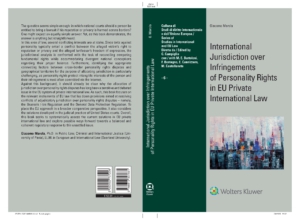
Giacomo Marola’s International Jurisdiction over Infringements of Personality Rights in EU Private International Law (2025 Wolters Kluwer) addresses a deceptively simple but persistently debated question: where should a claimant be entitled to sue when reputation, privacy, or personal data are infringed across borders? As the book makes clear from the outset, this question lies at the intersection of private international law, fundamental rights, and the realities of online communication. Personality rights disputes are structurally conflictual, typically opposing the protection of moral integrity to freedom of expression, while the Internet continues to strain jurisdictional rules built around territorial connecting factors. Against this backdrop, the book offers a timely and systematic assessment of the EU framework.
Chapter I constitutes the analytical core of the work. It provides a detailed examination of Article 7(2) of the Brussels I-bis Regulation and the Court of Justice’s case law on the ‘place of the harmful event’ in personality rights disputes. From Shevill to eDate Advertising, Bolagsupplysningen, Mittelbayerischer and Gtflix, Marola carefully examines the construction of locus actus and locus damni, focusing in particular on the publisher’s place of establishment, the persistence of the ‘mosaic’ approach, and jurisdiction based on the victim’s centre of interests. The chapter goes beyond doctrinal reconstruction by assessing these solutions against the objectives of proximity, predictability, and procedural balance, and by advancing a well-argued proposal de lege ferenda.
Chapter II places the EU approach in comparative perspective through an analysis of US jurisdictional doctrine in defamation and online tort cases. By retracing the path from Keeton and Calder to the rise and decline of the Zippo test and the renewed prominence of the ‘effects’ doctrine, the chapter sheds light on both convergences and structural differences. In doing so, it provides a useful corrective to overly enthusiastic transatlantic borrowings sometimes found in the European literature.
The final chapter turns to the General Data Protection Regulation and its interaction with the Brussels I-bis Regulation. Chapter III examines both public and private enforcement mechanisms, with particular attention to Article 79 GDPR and its implications for jurisdictional choice in data protection litigation. By integrating GDPR disputes into the broader analysis of personality rights, the book captures an increasingly central area of cross-border litigation.
Overall, the monograph combines doctrinal precision, critical insight, and pragmatic proposals, making it a valuable contribution for scholars and practitioners engaged with jurisdictional questions at the crossroads of EU private international law and fundamental rights.