RabelsZ 89 (2025): Issue 4
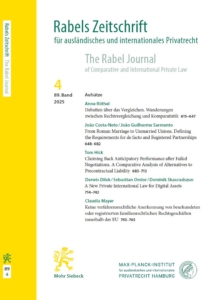
The latest issue of RabelsZ has just been released. The table of contents is available here. All content is Open Access: CC BY 4.0. More recent articles and book reviews are available Online First.
ESSAYS
Anne Röthel, Debatten über das Vergleichen. Wanderungen zwischen Rechtsvergleichung und Komparatistik [Debates about Comparison. Journeys between Comparative Law and Comparative Literature], pp 615–647, https://doi.org/10.1628/rabelsZ-2025-0060
Many academic fields look to comparative methods in pursuit of insight, with scholars debating how to proceed and what they hope to learn from the comparison. This article explores what comparative law stands to gain from interdisciplinary dialog with other fields of comparative inquiry. By way of example, it evaluates the potential gain from several journeys into the field of comparative literature. At first, these journeys back and forth between disciplines reveal a number of parallels: a striking resemblance between each field’s narrative of its own becoming; both fields’ exposure to fundamental criticisms; both fields ethicizing along similar trajectories; each one’s encounter with related dilemmas. At the same time, these journeys into comparative literature reveal implicit hierarchies and orientations in comparative law. But these cursory journeys through the history of comparative literature also counsel that comparative law would do well to avoid letting its own debates over the direction of the field veer into polarization and name-calling, into a kind of struggle that is mostly unwinnable and unproductive.
João Costa-Neto, João Guilherme Sarmento, From Roman Marriage to Unmarried Unions.
Defining the Requirements for de facto and Registered Partnerships, pp. 648–682, https://doi.org/10.1628/rabelsZ-2025-0059
This study examines the historical and comparative evolution of family law, tracing the transition from Roman marriage to contemporary partnerships. The article explores how Roman law conceptualised marriage as a social institution based on affectio maritalis, detailing its transformation through Christian doctrine into an indissoluble sacrament and its subsequent adaptation within modern legal systems. By analysing legal frameworks in Germany, Italy, France, England, and Brazil, the inquiry highlights the varying degrees of recognition granted to unmarried unions, from informal cohabitation to registered partnerships. The comparative analysis reveals the dynamic interplay between tradition, societal norms, and legal evolution, underscoring how distinct legal systems balance autonomy and protection in family law. This work contributes to the broader discourse on the harmonisation of family law and the impact of evolving societal values on legal institutions.
Tom Hick, Claiming Back Anticipatory Performance after Failed Negotiations.
A Comparative Analysis of Alternatives to Precontractual Liability, pp. 683–713, https://doi.org/10.1628/rabelsZ-2025-0049
As a matter of principle, breaking-off negotiations or refusing a contract offer are lawful actions. For based on freedom of contract, each individual is free to contract, free to choose one’s counterpart and the content of the contract, and equally free not to contract. Only exceptionally can a party be held liable for breaking-off negotiations based on wrongful conduct. Hence, it appears worthwhile to look for alternative approaches to recover fruitlessly incurred costs in the context of negotiations that failed independently of any wrongful conduct. Undue payment offers precisely this possibility. Therefore, the present contribution offers an exploratory look at the chances of success of an action for undue payment to recover costs incurred in the context of failed contract negotiations in Belgium, France, the Netherlands, and Germany. The paper finds that in those cases where fruitlessly incurred costs technically qualify as a payment in the respective national legal system, the prospects for the party seeking to recover these costs are surprisingly positive.
Derwis Dilek, Sebastian Omlor, Dominik Skauradszun, A New Private International Law for Digital Assets, pp. 714–742, https://doi.org/10.1628/rabelsZ-2025-0053
The increasing popularity of digital assets presents significant challenges for private international law, as fundamental conflict-of-laws rules concerning proprietary issues are often absent. This article outlines a possible approach to a technologically neutral and function-based conflict-of-laws framework. Taking existing instruments into account, it examines in particular the role of party autonomy through a choice-of-law rule, as well as alternative connecting factors based on structural, functional, or factual links between digital assets and legal systems. Building on this, the article proposes a conflict-of-laws framework for determining the law applicable to proprietary issues. This framework is designed to be applicable to various types of digital assets, including those based on decentralized networks. The proposed draft rule combines an express choice-of-law option with a multi-layered system of objective connecting factors and includes supplementary mechanisms for cases where the applicable law lacks substantive provisions.
Claudia Mayer, Keine verfahrensrechtliche Anerkennung von beurkundeten oder registrierten familienrechtlichen Rechtsgeschäften innerhalb der EU, [No Procedural Recognition of Acts Affecting Personal Status Based on Certificates Issued by Public Agencies within the EU], pp. 743–765, https://doi.org/10.1628/rabelsZ-2025-0058
In EU law, there is a discernible tendency on the part of the EU legislature to subject legal acts to procedural recognition – including as to their substance – based on certificates of recording or other kinds of documents issued by public agencies. It has therefore already been argued in the literature that a change of method has taken place whereby the conflict-of-laws as well as substantive review in the receiving state has been replaced by a recognition system. But this position must be rejected; generally, such documents issued by public agencies, from a procedural point of view, only have formal probative value. If the validity of the underlying legal act is ultimately uncertain from the point of view of the originating state and if no (procedural) position can be established based on the state’s participation, the substance of the act may and must be re-examined by the receiving state in accordance with the law designated by a conflict of laws examination there, even at the risk of creating a limping legal relationship. The ECJ’s case law on Art. 21 of the TFEU does not alter this principle. To further prevent limping legal relationships at the European level, what is needed instead is better standardization of the conflict of laws in EU secondary law.
BOOK REVIEWS
This issue also contains several reviews of literature in the fields of comparative private and private international law and on related topics (pp. 766–820).