Book review: Research Handbook on International Child Abduction: The 1980 Hague Convention (Edward Elgar Publishing, 2023) – Part I
Written by Mayela Celis, Maastricht University
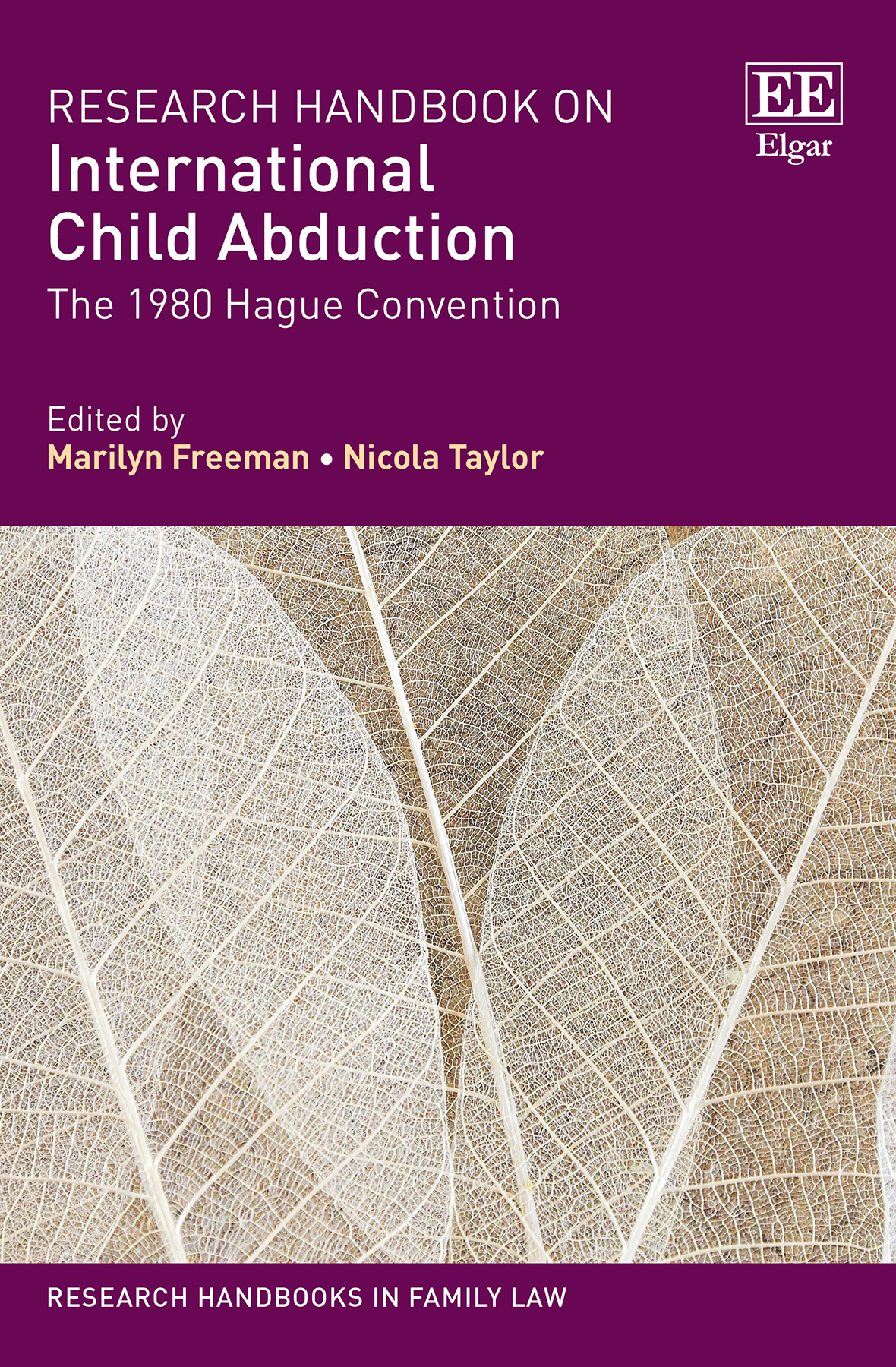
International child abduction is a topic that has given rise to an ever-increasing number of publications (our latest blog post attests to this trend). It easily sparks emotions among experts, sometimes triggering divergent views. However, from a global perspective, there is consensus on the basic principle: States should combat international child abductions and a child should be returned to the State of habitual residence, unless an exception is made out. In 2023, Elgar published the book entitled “Research Handbook on International Child Abduction: the 1980 Hague Convention”, eds. Marilyn Freeman and Nicola Taylor (Edward Elgar Publishing Limited, 2023). Although published a couple of years ago, it remains poignantly relevant.
This book brings together an adult who was abducted as a child, practitioners, judges, academics, NGO officials and central authority personnel. Many of the authors are at the forefront of this field and their contributions have left a long-lasting legacy in this area of law. While some topics are considered from an academic perspective, others have a more practical focus, striking the right balance between academia and practice.
This book review will be divided into two parts. The present and first post will deal with Part II to Part VI of the book. The second post will consider Parts VII & VIII and will include some personal views. The table of contents is available here.
This book is divided into 8 Parts:
- PART I – Introduction and key themes
- PART II – The impacts of international child abduction
- PART III – The 1980 Hague Convention – History and longitudinal trends
- PART IV – The 1980 Hague Convention – Implementation and operationalisation
- PART V- International child abduction in selected geographical regions
- PART VI – Non-Hague Convention countries
- PART VII – Key perspectives on international child abduction and Hague Convention proceedings
- PART VIII – Reflection and future directions
At the outset, it should be noted that this book has been dedicated to the memory of Anne-Marie Hutchinson for her invaluable contribution to this field.
Part II – The impacts of international child abduction
This Part begins with the long-term reflections of a former milk carton kid (Chapter 2 – FINKELSTEIN WATERS). A personal story of a woman who remembered seeing herself on a milk carton, when she was abducted as a child by her father and on the run, as part of a nationwide advertisement to find missing children. She recounts her life after her abduction from Norway to the United States, the previous abduction of her brothers from the United States to Israel and then to Norway, and the actions she has taken against child abduction, which includes speaking widely to the media and working with Lady Catherine Meyer, a left behind parent and founder of PACT.
It then moves on to discuss the psychological issues in child abduction and high conflict cases (Chapter 3 – CALVERT). The Chapter is rightly entitled in part “Ghosts in our Genes”, given that children in high conflict cases are haunted by these ghosts (or traumas) way into adulthood. It addresses the impact of developmental issues, parenthood and the voice of the child, noting that children want to be involved and valued, acknowledged and respected.
Part III – The 1980 Hague Convention – History and Longitudinal Trends
Part III begins by providing a historical context of the Hague 1980 Child Abduction Convention (subsequently, Child Abduction Convention or Convention), including some notable US developments preceding the treaty and a description of the Hague drafting process (Chapter 4 – ELROD). It also incorporates useful insights into the post-ratification history of the Convention and of the role of the HCCH as a leader in creating international family law.
This Part then continues with the value and challenges of statistical studies on the Child Abduction Convention (Chapter 5 – LOWE, STEPHANS). This article is written by the persons commissioned to draft these statistical studies so it is all the more valuable. After explaining the origin of the global studies, among other topics, it describes the modern statistical studies’ findings, such as the number of Hague applications and the outcomes. Beyond the descriptive nature of this article, it also provides useful insider information about funding issues, methodology, difficulties experienced, and challenges ahead. As stated in this article, this contribution was unable to take on board the latest study conducted on the basis of data of the year 2021, which provides valuable information regarding child abduction and the coronavirus pandemic, and which was prepared by the authors of this contribution (for more information, see Prel. Doc. No 3 of January 2023 of the 2023 Special Commission).
A note to the reader: although it was an idea left open by the authors, it should be noted that in 2021 the HCCH Council on General Affairs and Policy (CGAP Conclusion & Decision No 19) mandated the discontinuance of INCASTAT, an electronic statistical database.
PART IV – The 1980 Hague Convention – Implementation and operationalisation
Part IV begins with the role of the Permanent Bureau in the operation of the Child Abduction Convention (Chapter 6 – GOH ESCOLAR). This article starts with the role of the Permanent Bureau, the secretariat of the HCCH, and lists some of its tasks, which include: preparing, organising sessions and meetings, supporting the proper operation of the Child Abduction Convention, providing post-convention assistance (such as country profiles, holding seminars and INCADAT), facilitating communications and maintaining networks (including the International Hague Network of Judges and the Malta Process), organising and participating in international meetings, and maintaining of HCCH Regional Offices (in Latin America – ROLAC – and the Caribbean and Asia Pacific – ROAP -) and their key role.
A note to the reader: As of July 2025, there is a new HCCH Regional Office in Rabat, Morocco. For more information, click here.
It then moves on to the extremely relevant chapter on helping battered mothers and their children using Article 13(1)(b) (Chapter 7 – EDLESON, SHETTY, FATA) – . The authors begin by contextualizing the problem and setting forth decades of social research on domestic violence and their effects on battered women and children. This article then continues by analysing court decisions where the grave risk exception has been applied. It also discusses the Hague Domestic Violence project. Finally, it provides concrete recommendations to the Permanent Bureau of the Hague Conference and suggests possible actions for Central Authorities and practitioners. In particular, some recommendations to the Permanent Bureau include: encouraging the recognition that the exceptions to the return of children are an integral part of the Convention, focusing on the protection of children rather than adopting a technical approach to this treaty, and facilitating the drafting of a new revised edition of the Guide to Good Practice on Article 13(1)(b) with more comprehensive information on domestic violence. It should be noted that one of the authors has spearheaded research in this area with the ground-breaking book Battered Women, Their Children, and International Law: The Unintended Consequences of the Hague Child Abduction Convention (Northeastern University Press, 2012).
Subsequently, this Part deals with child participation and the child objection exception (Chapter 8, SCHUZ). This Chapter is divided into child participation and the child objection exception. With regard to the child participation, the direct and indirect hearings and separate representation are considered, with the author underscoring the need to convey the views of the child and not only the perceptions of the child’s interest, as well as the benefits of separate representation. Concerning the child objection exception, this chapter analyses the exception in a very structural manner by dividing in age and maturity, child’s objection including strength and validity and finally, the tricky question of discretion, which the author divides into welfare and convention considerations. Importantly, the author calls for internalising children’s rights when considering this exception and the adoption of a more child-centric approach.
Finally, this Part discusses a 20-year evolution in judicial activism (Chapter 9 – THORPE). The author was the first to table the proposal in 1998, on behalf of the UK, to create the International Hague Network of Judges. This chapter recounts the developments of direct judicial communications and of this network from their origin to up to 2021. With the support of key articles published in the HCCH Judges Newsletter, as he argues certain loss of memory – even to reminiscence his life during the Second World War -, the author takes us on the long journey of these initiatives, providing inside information and interesting details of the conferences held in the southern part of the Netherlands in the late nineties, in Brussels in 2009, and ending with some perspectives and conclusions during the corona pandemic. Importantly, he notes that “this is a history of harmony since, apart from the earliest days, there has been no real dissent and there is not a single case in which miscarriage of justice has resulted from an abuse of the general principles governing direct judicial communications.”
Part V – International child abduction in selected geographical regions
This Part focuses on the developments in two European regional courts and specific regions or States.
This Part begins with an analysis of the case law of the European Court of Human Rights (ECtHR) (Chapter 10 – KRUGER / LEMBRECHTS). This contribution is divided into the court’s role in international child abduction and the exceptions to return. The former deals primarily with Article 8 of the ECHR (and to a lesser extent art. 6) in areas such as the voice of the child and the duty to act expeditiously, while the latter provides a summary on the ECtHR case law on the exceptions under the Child Abduction Convention (arts. 12(2), 13(1)(a) and (b), 13(2) and 20). At the outset, this article includes a useful list of cases initiated by left-behind parents and by abducting parents (footnotes 7 and 8), from which conclusions may be drawn as to existing trends (see in particular that the cases heard before the Grand Chamber were initiated by abducting mothers). Importantly, references are made throughout this contribution to X v. Latvia and its impact on the best interests of the child and the exceptions under the Child Abduction Convention. It also includes relevant recent cases and a couple of interesting cases belonging to – what I refer to as – the “twilight zone”, that is the uncertain period between the Grand Chamber judgments of Neulinger and X v Latvia. Among their conclusions, they note that while the case law of the ECtHR is only binding on the members of the Council of Europe, its guidance can be useful to other States.
This Part then goes on to analyse the role of the Court of Justice of the European Union and international child abduction (Chapter 11 – HONORATI). It focuses on the relevant provisions of Brussels II ter, putting an emphasis on key concepts such as habitual residence and studying the court’s case law on this concept which amounted to 9 decisions as of July 2022 (see footnote 19 – citing benchmark cases such as A and Mercredi v. Chaffe, among others). Importantly, a section is devoted to the retention of jurisdiction, in which emphasis is laid on the differences between Brussels II ter and the 1996 Hague Convention. It then moves on to study return proceedings, including the child’s safe return and the overriding mechanism. Finally, the author submits that the guidance provided by the CJEU may be of interest to courts located in third States and may be of some value when dealing with similar topics.
Subsequently, Part V delves into the study of specific geographic regions or States: Australasia and the Pacific, United States, Asia, Africa and the Caribbean region.
With respect to Australasia and the Pacific (Chapter 12 – HENAGHAN / POLAND / KONG), it makes a recount of the developments of child abduction in Contracting and non-Contracting Parties to the Child Abduction Convention. First, it analyses key concepts such as rights of custody and habitual residence, as well as the most litigated issues under the Child Abduction Convention (in particular, the exceptions) in Australia, New Zealand and Fiji. It underlines the differences and similarities among these jurisdictions. Subsequently, it describes the (national or convention-inspired) procedures adopted by Pacific countries that are not Contracting Parties to the Convention when dealing with international child abduction, including Tonga’s steadfast intention not to join this treaty and Samoa’s review of family law.
With regard to the United States (Chapter 13 – CULLEN, POWERS), it describes the robust interpretation of the Convention in this State, noting that the US Supreme Court has rendered judgments in five key cases so far. The article focuses on two of those cases (Monasky and Golan), and touches briefly upon Abbott. Interestingly, this article pinpoints recent federal court judgments that may have an important impact on the operation of the Convention. It also raises the need to deal with the mature child exception in the United States. This Chapter should be read in conjunction with Chapter 7 (Fleeing for safety…).
With respect to Asia, Chapter 14 – NISHITANI focuses primarily on developments in Japan, with some brief references to other Asian countries (such as India and Pakistan). It starts by outlining the reason why it has been a challenge for Asian States to join the Convention. It then analyses the way key Convention concepts have been interpreted in Japan, including two Japanese Supreme Court judgments (2017 and 2020) regarding the change in circumstances when executing return orders and objections of the child. References to other useful Japanese INCADAT cases are included throughout this article. The author also discusses the reform to the Implementation Act and the Civil Executive Act of Japan in 2019 and helpfully suggests improving it by introducing ex officio enforcement mechanism (as opposed to relying on a party’s initiative). Finally, this article refers to the Malta Process, after sharing an interesting reflection on Islamic countries, the author makes a call for States to join the 1996 and 2007 Hague Conventions and Protocol, arguing that these treaties will support a safe return of the child.
With regard to Africa, Chapter 15 (SLOTH-NIELSEN) discusses primarily developments in South Africa, a country with vast jurisprudence on this topic. It begins with an analysis of the benchmark case Sonderup and Tondelli and the interplay of the Convention with the best interests of the child, as well as other South African cases. It also briefly mentions two outgoing cases from Morocco, decided in France and the United States, and legislation from Mauritius. Acknowledging that jurisprudence in this region is scant (apart from South Africa), the author suggests further judicial training in the region.
Regarding the Caribbean region, Chapter 16 (GORDON HARRISON) provides a summary of the status quo in this region regarding international child abduction. It includes a useful table with a list of 32 countries/territories in the Caribbean region and their status (independent State or a territory/country of a State – i.e. UK, France, the Netherlands, USA -). Information is included regarding specific States parties to the Convention (incl. any acceptances of accessions, which may be challenging to determine in the case of territories. Each State must extend the Convention to that particular dependent territory and this extension must have entered into force), and any designations to the Hague Network Judges. This chapter highlights that even in non-Contracting States, the spirit of the Convention has been persuasive (see p. 240, regarding Jamaica before acceding to the Convention) and that judges have been designated for the Hague Network in non-contracting countries (Suriname, Aruba and Sint Maarten). It ends with a useful list of challenges, recommendations and conclusions, which include judicial training and the development of internal guidelines.
A note to the reader: Just for the sake of clarification, it should be noted that St. Kitts and Nevis accepted the accession of Peru and not otherwise, and that Trinidad and Tobago has accepted 5 instead of 6 accessions.
Part VI – Non Hague Convention Countries
This Part deals with non-Hague Convention countries and more specifically, with India. Throughout the book reference is made to the fact that India is not a party to the Child Abduction Convention and what that means for children and families, given the mobility of the Indian population.
In this regard, the reader should bear in mind that this Part should be read in conjunction with Chapter 12 (Australasia and the Pacific), which includes research on Island nations not yet a party to the treaty, such as Samoa and Tonga, Chapter 14 (Asia), which refers to the hesitancy of India to join and information regarding Islamic States, and Chapter 16 (the Caribbean region), which refers to non-Contracting Parties, such as Suriname, and the lack of acceptances of accessions – the Convention applies bilaterally for acceding States and thus in the case of a lack of an acceptance to an accession, the Convention does not apply -.
With regard to non-Hague Convention countries, Chapter 17 (MORLEY) provides, from a practitioner’s perspective, an overview of the existing practices in some non-Contracting States (including in those the author has litigated, such as a case between Japan and Bangladesh). He begins his contribution by noting the existence of bilateral agreements and MOUs on family law matters, the latter of which have proven to be deficient or highly ineffective. The author also emphasises the Malta process and lists highly useful strategies to recover children from non-Hague countries. This Chapter also deals with India (see pp. 244, 252-253, 256).
With respect to India, Chapter 18 (MALHOTRA, MALHOTRA) briefly analyses the Indian legislation under which a return may be requested and concludes that a writ of Habeas Corpus is the only means available. It then moves on to consider the Indian case law, in particular the numerous – and very contrasting throughout the years – judgments of the Indian Supreme Court, which is undoubtedly the more interesting part of the article. It starts with the historical position adopted by the Indian Supreme Court and the dramatic shift in position in 2017, with the abandonment of principles such as “first strike” (first seized) and the primacy of comity of Courts, as well as the concept of forum conveniens in these matters. It also analyses Supreme Court decisions rendered in 2019, as well as features the widely publicised case of Jasmeet Kaur v. Navtej Singh. Importantly, it briefly explains the Indian failed attempt to gear up to become a party to the Child Abduction Convention and the sterile bill resulting from those efforts. It concludes by praising the emergence of mirror order jurisprudence in child custody matters, which has been adopted in an Indian-USA case.
Part II of this post will be published later on in 2026… stay tuned and Happy New Year!